Drivers connect UKG access
Driver work schedules sync automatically from UKG, bringing their shifts into the shuttle planning workflow.
Technical build story · Java / Spring Boot
Is the Shuttle Running? is being piloted at Six Flags Fiesta Texas in San Antonio. Drivers connect UKG access so their work schedules sync automatically for shuttle assignments. The team can also view scheduled clock-out times to plan pickups for employees with mobility impairments. I built the application through Renatus, drawing on my experience in employee transportation and wardrobe operations.
The product
Driver work schedules sync automatically from UKG, bringing their shifts into the shuttle planning workflow.
The driver schedule provides the shift information used to plan shuttle coverage and driver assignments.
Managers can see scheduled clock-out times to plan pickups for employees with mobility impairments around the end of their shifts.
A public page shows whether the shuttle is running and the active driver’s first name. Riders can check it from any browser using their organization’s shared link.
Signed-in drivers use an NFC or QR checkpoint to start, pause, resume, end, or hand off service. Each actual driving segment becomes part of the history.
Date and driver filters show who drove, when they started and stopped, and how much time they drove. Paused time is excluded, and managers can close forgotten runs.
Currently being piloted at Six Flags Fiesta Texas. An independent product built and maintained by Renatus Technology.
Implementation
One server-rendered Java 17 / Spring Boot application, with Spring MVC, Spring Security, Thymeleaf, Spring Data JPA, MySQL, and Flyway.
Checkpoint actions lock the organization and read the active session for update. A handoff closes the old segment and opens the next in one transaction; stale action forms are rejected.
Authentication alone is insufficient. Services check membership and resource ownership, and drivers must use their own account. Possessing a tag link does not replace those checks.
Reports use the operations timezone and clip overlapping runs to the requested dates. Active runs contribute elapsed time. Pauses create no driving segment and add no driving time.
The rider controller supplies an organization name, a binary running state, and the active driver’s first name. Operational notes and internal records stay outside that view.
Drivers explicitly pause or end a run, and managers can close a session with its actual end time. These controls keep session changes tied to recorded actions.
JUnit and Spring integration tests use MySQL through Testcontainers. GitHub Actions runs the Java and JavaScript checks and builds the production Docker image.
Inside the application
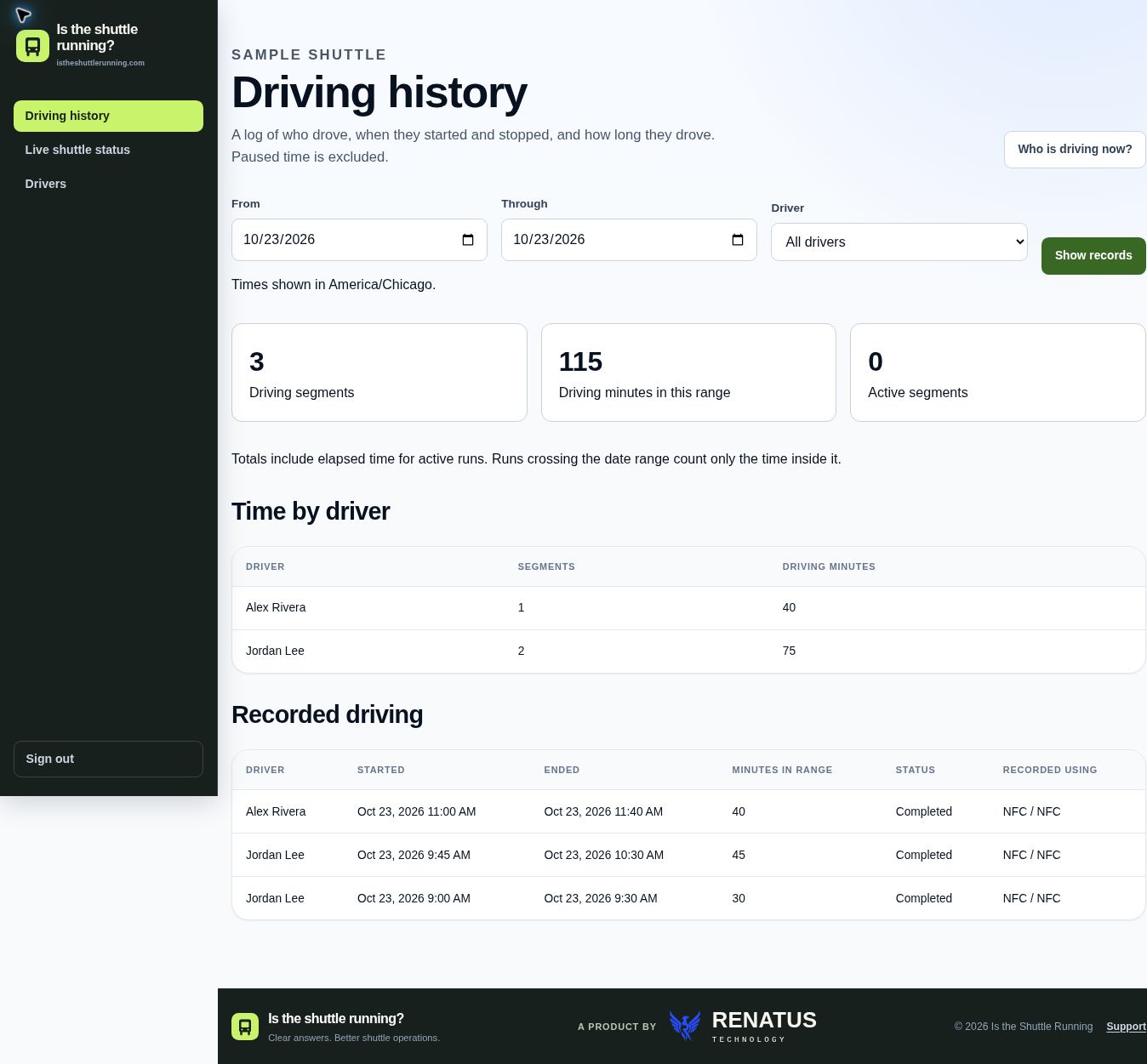
See the rider and driver screens and how the sample data was produced.
My role
I worked on the requirements, Java services, relational schema, role-specific screens, NFC/QR workflow, tests, deployment configuration, and maintenance. Development includes AI assistance; the source and tests provide concrete material for technical review.
Each organization has its own driver access, active service, and driving records. In the Six Flags Fiesta Texas pilot, UKG schedule syncing and scheduled clock-out visibility also support driver assignments and mobility pickup planning.